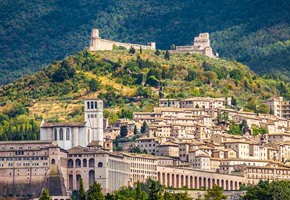
Initially founded by the Umbrian people, Assisi became an
important Roman town from the 3rd century BC onwards. In 238AD the
town was converted to Christianity - which would later be of great
significance to the town's most famous son. Assisi had a constant
battle to remain independent of Perugia in the Middle Ages, though
ultimately these attempts were futile.
By the early 13th century the town was suffering a deep decline
after the Black Death decimated its population. Yet at about this
time, Assisi came under Papal jurisdiction from Perugia, and a
number of its buildings (in a poor state after the battles with
Perugia) were rebuilt in a grander style. It began to develop
rapidly at this time, and soon it expanded beyond its city
walls.
Holy Assisi
It was also during this time that St Francis, a leading figure
in the Christian faith, founded his Order and was the subject of
adoration. Assisi experienced something of a golden age at this
point. The magnificent Basilica of Santa Maria degli Angeli - one
of Assisi's best-loved landmarks - was built in the 1570s, though
by this time the city was experiencing something of a decline due
to tight control from the Papacy. For a number of years Assisi was
virtually forgotten, until in 1939 St Francis was declared the
patron saint of Italy. Tourists and pilgrims alike flocked to the
city to see where the great man had spent the early years of his
life, and were delighted to find the beautiful,
immaculately-preserved city that stands today.



 Classic